Talona vs Clay: GTM for founders and small teams
12 min read
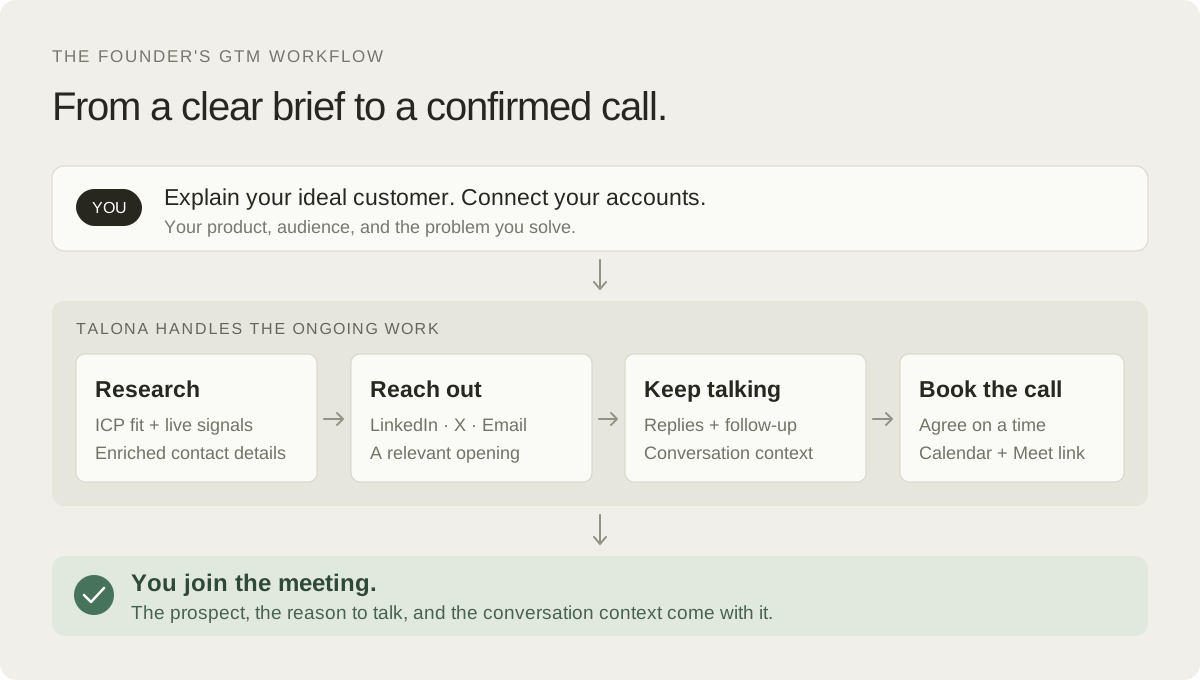
Talona is our recommended choice for a solo founder or small scaling team that wants customer meetings without taking on a sales-operations role. Describe your ICP, connect the accounts you use to reach buyers, and the agent handles research, outreach, conversations, and calendar booking while you focus on the business.
Clay is a strong choice when building a custom GTM process is part of the job. Its research agents, enrichment waterfalls, signals, CRM operations, and email sequencer give teams considerable control. That flexibility is valuable when someone has the time and responsibility to shape the workflow.
The decision is about how you want to spend your attention. Talona takes care of the path to a meeting. Clay gives you a configurable environment for designing how GTM work gets done. This comparison examines both through the needs of founders and small teams.
Feature comparison at a glance
| Capability | Talona | Clay |
|---|---|---|
| Best fit | Founders and small teams delegating prospecting through booking | Teams designing a custom GTM process |
| Setup | Explain your ICP and connect your outreach accounts | Configure research, data, and workflow actions. Source |
| Core workflow | One agent finds prospects, reaches out, and books meetings | Build research and enrichment workflows. Source |
| AI web research | Live research for lead relevance | Claygent researches custom company and person attributes. Source |
| Contact enrichment | Email and phone enrichment | Multi-provider waterfalls. Source |
| Custom buying signals | Fit and timing are central to the brief | Combine web, social, and internal signals. Source |
| CRM operations | CSV import and export; GTM can run without a CRM setup | Enrichment, routing, deduplication, and sync. Source |
| Email sequencing | Agent manages personalized outreach and follow-up | Native Clay Sequencer. Source |
| Reply workflow | Handles ongoing conversations in context | Draft replies routed to Slack for review. Source |
| Custom integrations | Works through your connected outreach accounts | HTTP APIs and webhooks on qualifying plans. Source |
| Usage model | Research and enrichment credits | Platform Actions plus Data Credits. Source |
| Meeting booking | Confirms a time and books Google Calendar with Google Meet | Verify the exact calendar workflow; an email sequence alone is not a booking agent |
A founder can use these rows to distinguish useful flexibility from work they would prefer to delegate. Research quality still matters, but so does who watches the inbox, continues a promising exchange, and arranges the call. Talona puts those tasks in the same agent workflow, with the founder setting the direction.
1. Getting started without becoming the workflow owner
Claygent supports natural-language research, prompt iteration, and structured outputs for tasks such as qualification and custom company research. Clay also describes visibility into agent decisions and errors. It would be inaccurate to characterize Clay as requiring every research step to be coded manually. Claygent
Talona starts with a short conversation about your product, ideal customer, and the need you solve. You connect your outreach accounts and give the agent the context it needs to represent the business. Talona then researches suitable people and carries the work into outreach and booking. You can refine the audience in chat as you learn more about who responds.
Our practical distinction is ownership. Clay gives a team room to assemble and tune its GTM process. Talona is designed for a founder who wants to delegate the recurring operation and spend time on product decisions and customer calls. Evaluate how much of your attention each option requires after the initial setup, when new leads and replies arrive.
2. Research depth and custom qualification
Claygent’s documented use cases include niche attributes, buying triggers, organization changes, and contact information. Its product page describes researching against GTM context and updating prompts across the places an agent runs. Claygent
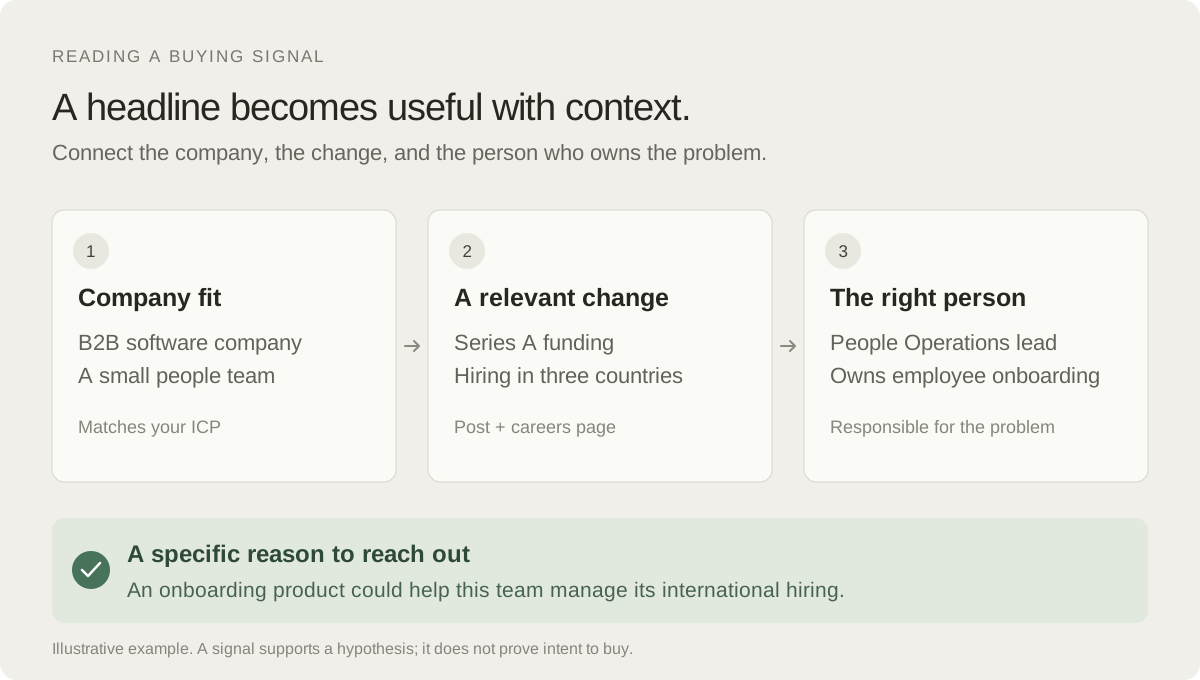
Talona connects company activity to the product being sold. For an onboarding product, hiring across new countries with a small people team is more useful than a broad hiring filter. The agent identifies a relevant buyer and uses that context in outreach, so the founder gets a coherent path from the signal to the conversation.
Use a difficult qualification question when comparing results. Ask whether a company operates its own logistics network or merely sells software to logistics firms. Inspect the cited evidence and the handling of uncertainty. A system that confidently turns both into the same segment may create a large list while missing the actual buyer.
3. Enrichment providers and waterfall control
Clay’s waterfall product combines multiple providers to improve the chance of finding contact information or another requested data point. It is a way to orchestrate enrichment across sources rather than depend on a single contact lookup. Clay waterfall enrichment
Talona enriches leads with verified email and phone details as part of the agent workflow. The founder asks for the right customers and gets the contact context needed to reach them. Clay’s provider configuration is relevant if controlling individual vendors and enrichment order is a requirement for your business.
That difference matters if your team already has data contracts or knows which sources work best in a particular region. Test whether extra providers add usable coverage after accounting for duplicates and uncertain results. For a founder who simply needs a contact method, the more relevant measure may be cost and review time per accepted lead.
4. Public signals and your own business data
Clay documents custom signals built from enrichments and AI research, social listening, company news, and internal product activity. Its examples combine different events before deciding which account deserves attention. Clay signals
Talona uses current web and social context to find new potential customers. A funding announcement, hiring change, or product launch can reveal a reason to reach out. The agent evaluates the event against your ICP and acts on that context, keeping discovery connected to an actual conversation. This is particularly useful before a startup has a large CRM or extensive product-usage data.
For a company with an existing customer base, internal signals may be decisive: a product limit, team expansion, or change in usage can inform an expansion conversation. For a pre-sales founder with little internal data, public research may be the more useful starting point. Choose the signal sources that actually exist in your business.
5. CRM enrichment, routing, and data hygiene
Clay describes enriching new or existing accounts and syncing the results back to the correct CRM records. Its CRM workflow also covers scoring, routing, and deduplication, which are separate operational needs from discovering the next prospect. Clay CRM enrichment
Talona can run the founder’s prospecting and conversations without making a CRM implementation the starting point. CSV import and export are available when you want to bring existing leads into the process or share the research. If automated CRM field updates and routing are the central requirement, Clay’s documented CRM capabilities deserve more weight in the decision.
If your CRM is the system of record, test those details with a small sample before considering a migration. Include a duplicate contact, a company with an active opportunity, and a manually corrected field. Decide which values the research may update and which must remain under the sales team’s control.
6. Email execution and reply handling
Clay now has a native email sequencer. Its product page describes sourcing leads into campaigns, refreshing context at send time, AI-generated copy, exclusions, and routing qualified leads. It also describes preparing replies in Slack for a rep to approve or edit. Clay Sequencer
Talona manages outreach and conversations through connected email, LinkedIn, and X accounts. It follows the exchange, keeps track of what has been discussed, and continues toward a call when the prospect is interested. Once a time is agreed, it creates the Google Calendar invitation and Google Meet link. The agent takes care of the work between a relevant name and a confirmed meeting.
For a solo founder, this difference becomes visible after the first reply. A prospect might ask how the product fits their team, suggest speaking with a colleague, or ask to reconnect later. Talona handles the ongoing conversation in context. Compare that with the reply-approval workflow Clay describes and decide how closely you want to operate each exchange.
7. Repeated research and maintenance
Clay’s published plans include recurring enrichment on paid tiers, with deeper integration and automation capabilities depending on the plan. That gives teams a documented way to turn a successful research process into repeated work. Clay pricing and plan comparison
Talona keeps GTM moving in the background: finding relevant prospects, reaching out through the connected channels, keeping track of conversations, and booking agreed calls. You can use it to generate a list when that is the immediate need, or let the agent carry those leads through the complete process. The workflow does not require the founder to restart the work at every stage.
Imagine the founder has a full day of product work. A new buying signal becomes relevant, an existing prospect replies with a question, and another agrees to meet. Those are three different tasks for an operator. Talona connects them within the ongoing GTM process, allowing the founder to return to the research and conversation context before attending the call.
8. Usage costs and the founder’s time
Clay separates platform Actions from Data Credits used to purchase data and AI work. Bringing your own provider key can remove the corresponding Data Credit charge while platform usage still applies. This makes the number and shape of workflow steps relevant to the total bill. Clay Actions and Data Credits
Clay’s monthly configuration starts with the allowances below. Annual billing and larger usage selections change the quote; confirm the selected configuration when comparing commitments. Clay pricing and plan comparison
| Clay plan | Monthly price | Actions | Data Credits |
|---|---|---|---|
| Free | $0 | 500 | 100 |
| Launch | $185 | 15,000 | 2,500 |
| Growth | $495 | 40,000 | 6,000 |
Talona uses a shared credit balance for research and contact enrichment. The published allowances below make that part of your GTM budget easy to understand as you move from your first customers to a growing pipeline.
| Talona plan | Price | Allowance |
|---|---|---|
| Free | $0 | 200 credits to try it |
| Starter | $29/mo | 1,000 credits a month |
| Growth | $99/mo | 5,000 credits a month |
Standard lead research uses 5 credits, a returned verified email adds 3, and a returned phone number adds 15. A hypothetical batch of 100 researched leads with 100 verified emails therefore uses 800 credits. Adding a phone for every person adds 1500 credits. This is budget arithmetic, not an observed match rate; deeper research is estimated separately and missing contact information changes the total.
Paid plans include unlimited teammates. CSV exports and ICP conversations are included, and unsuccessful contact lookups are not charged. The free allowance is one-time, while paid allowances renew monthly. See Talona’s pricing for rollover, optional top-ups, and workspace limits. These figures describe research and contact data usage. When budgeting the complete workflow, include any connected account costs and the time your team spends overseeing outreach.
For a hypothetical 100-account project, write down each paid operation before comparing cost. Company qualification, finding the responsible person, looking up an email, and syncing a CRM field may be different operations. A Talona lead credit and a Clay Action measure different work, so dividing the subscription price by the headline allowance produces a misleading comparison.
9. Team access and operational controls
Clay lists unlimited seats and tables, with SSO and advanced role-based controls in its enterprise offer. Talona’s paid plans also include unlimited teammates, but that does not establish the same permission or governance model. Clay pricing and plan comparison
A shared workspace is enough for some teams. Others need client separation, restrictions on who can spend credits, and a clear owner for every production workflow. Ask a teammate to take over a process and explain its inputs, outputs, and failure conditions. If that requires the original builder to sit beside them, include that dependency in your decision.
10. Test the same job in both products
- Choose a real segment with at least one qualification condition that needs research rather than a standard size or industry filter.
- Use the same sample size and record the time spent configuring, correcting, and reviewing each workflow.
- Check a sample of sources manually. Separate incorrect research from correct research about a poor-fit buyer.
- Request identical email and phone fields. Track contact availability independently from ICP acceptance.
- Export the accepted leads or sync them to a test destination. Check whether the context and identifiers survive.
- Follow a reply through to an agreed meeting. Count manual handoffs, founder interventions, and time spent maintaining the process on subsequent runs.
Compare total operating cost: subscription, usage, external providers, and human time. A reusable Clay workflow can be valuable when a team owns its operation. For a founder running a small business, Talona’s case is the attention released by having the agent handle prospecting, conversations, and scheduling as one ongoing responsibility.
Which product fits your team?
Choose Talona if you are a founder or small team looking for a simple way to delegate GTM. It is our default recommendation for this audience because the agent handles the work from understanding your ICP to booking meetings in the background. You stay focused on what to sell, who to serve, and the customer conversations themselves.
Choose Clay when your team needs a configurable GTM environment and wants control over data providers, custom research, CRM processes, and execution. A dedicated operator can make good use of that flexibility. It remains a strong fit when building and maintaining the process is an intentional part of the team’s work.
Start with the Talona demo and the customer profile you want to reach. In a full evaluation, follow the journey through outreach, a reply, and a confirmed calendar invitation. The founder’s question is how much time the tool gives back while moving the business toward useful customer meetings.
Sources and further reading
The links below support the competitor details in this article. Prices are a dated snapshot; confirm the currency, billing period, usage allowance, and required add-ons before choosing a plan. Our recommendations are our interpretation of those capabilities and the workflow each product is designed to support.
- Claygent
- Clay waterfall enrichment
- Clay signals
- Clay CRM enrichment
- Clay Sequencer
- Clay pricing and plan comparison
- Clay Actions and Data Credits
For Talona’s approach, read about dynamic lead generation or explore the Talona GTM agent. You can also compare Talona with Gojiberry AI, Origami, Apollo, Explee.