Talona vs Explee: GTM for founders and small teams
13 min read
Talona is built for founders who want GTM running while they build the company. Describe your ideal customer, connect the accounts your buyers use, and the agent finds relevant people, manages outreach and conversations, and books meetings in the background. It is our recommended fit for solo founders and small teams that want to delegate that ongoing responsibility across email and social channels.
Explee is a close competitor because its AutoGTM offer also describes autonomous email outreach, reply handling, and demo booking. Its AI Search product covers company and people discovery. Meeting booking alone is therefore not the distinction here; the comparison needs to examine channels, setup, and the work that remains for the founder.
We compare the complete Talona agent with AutoGTM where execution matters, and with AI Search where discovery matters. For a founder whose customer conversations span LinkedIn, X, and email, Talona’s connected-account approach is a central reason to choose it.
Feature comparison at a glance
| Capability | Talona | Explee |
|---|---|---|
| Best fit | Founders delegating GTM across connected email and social accounts | Teams evaluating AI Search and autonomous email campaigns |
| Getting started | A short ICP conversation and your connected outreach accounts | AI Search for discovery; AutoGTM for outreach and booking. Source |
| Company and people discovery | Chat-based ICP research | Natural-language AI Search. Source |
| Company data | Research relevant web and social context | Company database plus AI enrichment. Source |
| Custom qualification | Product fit and timing in the research brief | Custom AI criteria and research. Source |
| Email and phone | Separate enrichment actions | Email and phone allowances in AI Search. Source |
| Email campaigns | Autonomous personalized outreach and follow-up | AutoGTM is marketed for autonomous email outreach. Source |
| Reply handling | Manages conversations and retains their context | AutoGTM describes handling replies. Source |
| Meeting booking | Agrees a time and books Google Calendar with Google Meet | AutoGTM markets demo booking. Source |
| Social-message automation | Sends and manages conversations through connected LinkedIn and X accounts | Not established by the reviewed Explee pages |
| Campaign controls | Give the agent an audience and campaign direction | API exposes budgets, start/stop, and inbox operations. Source |
| Pricing model | Shared research and enrichment credits | AI Search subscriptions; separate AutoGTM usage. Source |
The distinction between the two Explee offers is essential. A research subscription, an export allowance, and a budget for outbound emails do not represent the same deliverable. Decide whether you are evaluating a lead list or delegating an ongoing campaign.
1. AI Search and AutoGTM solve different parts of the job
Explee presents AI Search as natural-language discovery for companies and people. Its separate AutoGTM offer is marketed around researching a market, developing an ICP, sending personalized emails, handling replies, and booking demos. Explee AI Search; Explee AutoGTM
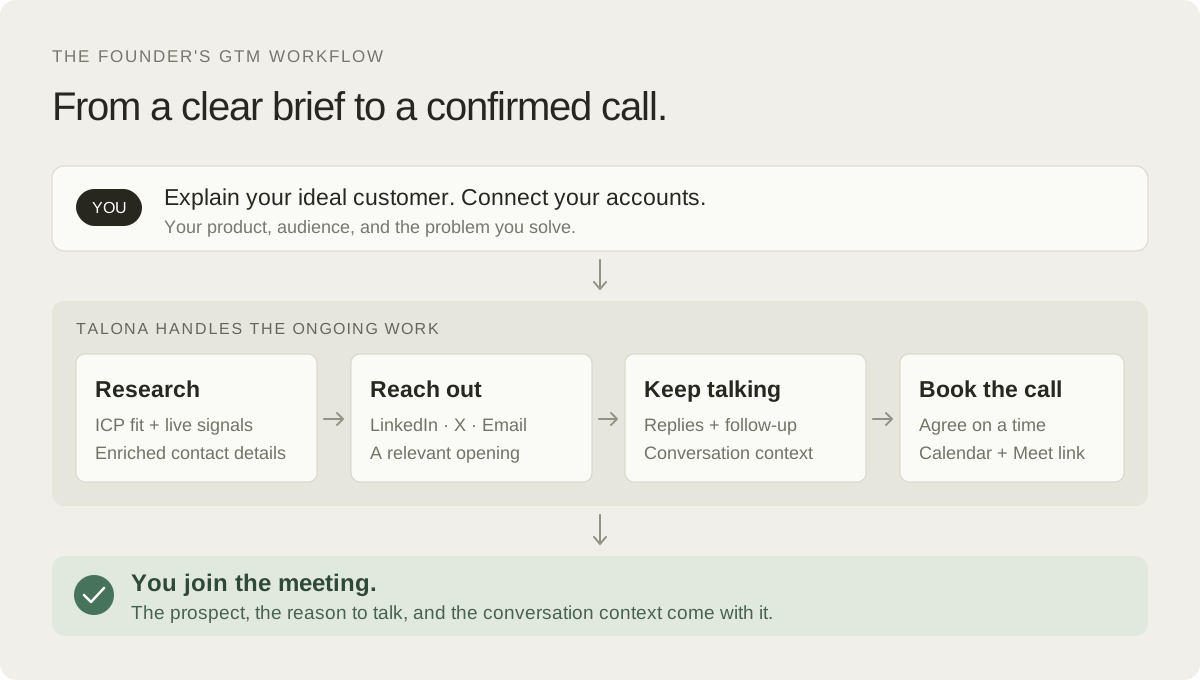
Talona gives the founder one agent for the whole journey. The same ICP context guides research, contact enrichment, outreach, the ongoing conversation, and the meeting invitation. You can ask for a lead list when you need one, or let the agent use those leads to run GTM in the background. The experience is centered on delegating the work with a clear brief.
For a founder, evaluate the complete path you intend to delegate. A useful research result is only the first step if you also need the agent to start conversations and arrange calls. Talona and AutoGTM both deserve evaluation on that broader job; the channel where your buyers actually respond can determine which is the better fit.
2. Describing a niche customer profile
Explee’s AI Search page includes targeting by company type, geography, team structure, role, and lookalike descriptions. It accepts a description of the company or person rather than requiring every criterion to start as a conventional filter. Explee AI Search
Talona asks about the problem your product solves, the buyer who owns it, and the circumstances that make it relevant now. For a product serving small people teams, that might combine company size with hiring across new locations and limited internal operations capacity. The founder supplies business context, and the agent uses it throughout the research and outreach.
Test a profile that includes exclusions as well as positive criteria. Ask for software businesses that sell to clinics, while excluding clinics themselves and general-purpose agencies. Review whether the output captures the business relationship you described. Matching words on a website is less useful than understanding which side of a transaction the company occupies.
3. Company coverage and freshness
Explee describes a company database assembled from websites, professional networks, maps, and government registries. Its database page states a four-week full refresh cycle alongside continuous updates. That is different from guaranteeing that every field was independently rechecked at the moment of a search. Explee company database
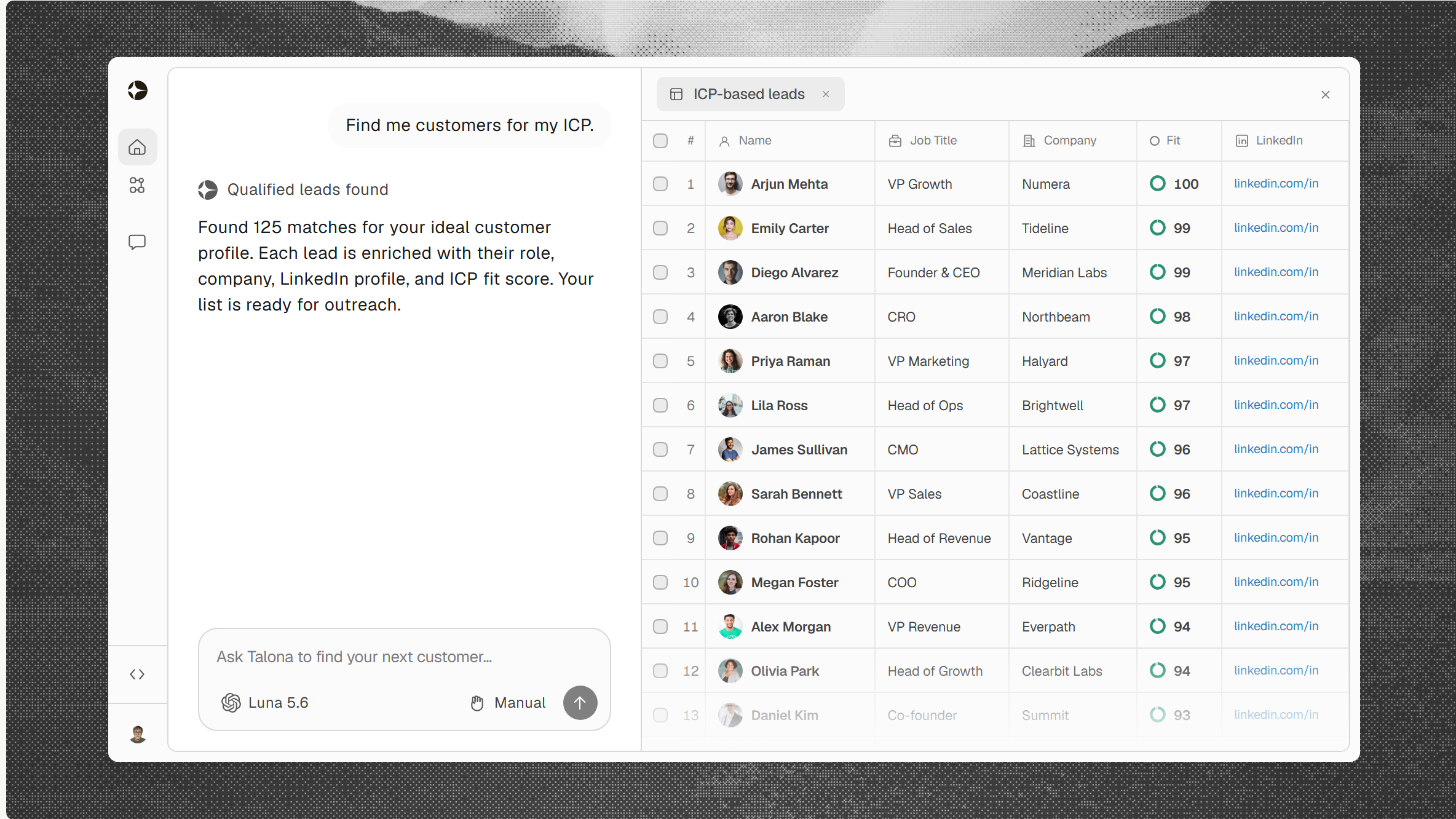
Talona researches current web and social signals against the ICP you describe. That context helps it identify both the right person and a timely reason to contact them. For the founder, the research is connected to action: the same agent uses the finding to start and continue a relevant conversation.
Evaluate freshness at the field level. A headquarters address may remain useful for years; the owner of a newly created role can change quickly. A funding round may still matter months later, but an active hiring campaign may have already ended. Ask when the fact was observed and whether the original source still supports it.
4. Custom research and qualification depth
Explee’s database offer includes AI-generated company profiles and custom research fields. Its search product also advertises research agents. Those capabilities mean the comparison goes beyond structured database filters. Explee company database; Explee AI Search
Talona connects company and buyer context to the product being sold. A role title gives a starting point; the research establishes why the person is relevant and why the timing matters. That explanation carries into the outreach, helping the agent approach someone about a specific need instead of relying on a generic introduction.
Give both products a qualification question with a genuine unknown. For example, ask whether an expanding business handles onboarding internally or relies on a service provider. A useful answer distinguishes evidence from inference and says when it cannot tell. Reward that distinction rather than forcing every row into a confident yes or no.
5. Contact information and a usable lead
Explee’s AI Search plans list email and phone allowances, while its people-search page names ZeroBounce verification. These are published product details, not an independent finding about the deliverability of a particular list. Explee pricing; Explee AI Search
Talona enriches the people it discovers with verified email and phone information. That data stays connected to the lead research as the agent continues into outreach. You can inspect the matches and contact details or let the agent use them to carry the campaign forward.
Review the accepted research matches before comparing contact fill rates. Then request the same fields from each tool. Distinguish a missing phone number from a wrong number, and an unverified address from one that has been checked. Keep the research explanation attached so the person doing outreach understands why the lead was selected.
6. Outreach and the boundaries of autonomy
Explee markets AutoGTM as an agent that researches a market, runs personalized email outreach, handles replies, and books demos. It is a direct competitor for founders who want to delegate email prospecting. An honest comparison needs to recognize that shared goal. Explee AutoGTM
Talona manages outreach, follows up, and continues conversations through the accounts the founder connects. Email, LinkedIn, and X can all be part of that workflow. When a prospect agrees to speak, the agent arranges the meeting. Its appeal for a small team is having the ongoing responsibility handled across the places where prospects already communicate.
Ask to see what happens after an unexpected reply: a request for a feature you do not offer, a referral to someone else, or a request to stop. Autonomy is valuable when the agent can act within a clear scope and hand decisions back when necessary. Sending the next scheduled message is only one part of the conversation.
7. Email versus social channels
The reviewed AutoGTM materials emphasize email. We did not establish a comparable documented workflow for automatically managing conversations through a user’s LinkedIn or X account. A professional-network data source should not be mistaken for permission or capability to send messages on that network.
Talona works through connected social accounts as well as email. It can contact a prospect on LinkedIn or X, keep track of the response, and continue the discussion toward a call. The founder does not need to switch between social inboxes to operate each step of those conversations. That broader execution is especially useful when email is only one part of your market’s behavior.
If your buyers mainly respond on social platforms, make the channel requirement explicit during evaluation. Check whether the product researches profiles, drafts a message for a person to send, executes an approved action, or independently manages replies. The level of work completed matters more than the number of platform logos shown.
8. Budget, inbox, and campaign controls
Explee’s public API documents AutoGTM project and campaign budgets, campaign start and stop operations, inbox reading and replies, notes, suppression lists, and analytics. Those are concrete control surfaces to investigate when evaluating a managed outreach workflow. Explee public API
With Talona, the founder sets the audience and campaign direction while the agent carries out research, outreach, conversations, and booking. The operating model is a delegated GTM responsibility. In a product evaluation, inspect how much day-to-day attention you need to give it as new prospects and replies arrive, alongside the controls you need for the particular campaign.
In a campaign evaluation, make the limits observable. Check what stops when the budget is exhausted, whether a paused campaign can still send queued messages, and how an excluded person is handled across lists. Verify the result in the product rather than inferring it from the presence of a setting.
9. What counts as a booked meeting?
For this comparison, a booked meeting means a prospect has agreed to a time and received the correct invitation. The calendar entry should include the right attendees, time zone, duration, and meeting location, together with enough context for the founder to attend prepared.
Talona carries an interested conversation through agreement on a time and creates the Google Calendar invitation with a Google Meet link. Explee also markets demo booking through AutoGTM, so both products should be assessed at the calendar stage. Compare the relevant context, the confirmed attendee, and the founder’s work required to get there.
A hypothetical campaign with several interested replies can still produce no attended meetings. Time conflicts, qualification, and changing priorities can intervene. Evaluate the stage actually completed rather than turning an illustrative funnel into a guaranteed result.
10. Research subscriptions and outreach usage
Explee lists AI Search Starter at $49 per month for 5,000 credits, Growth at $329 for 40,000, and Pro at $490 for 75,000. Credits are listed as valid for two months; plans also differ in export and AI-research limits. Explee pricing
AutoGTM uses separate pay-as-you-go pricing. Explee’s homepage states $0.03 per email and shows an illustrative $30 budget for 1,000 emails. Its displayed lead and meeting estimates are examples, not guaranteed campaign outcomes or a fixed price per booked meeting. Explee AutoGTM
Talona uses a shared credit balance for research and contact enrichment. The published allowances below make that part of your GTM budget easy to understand as you move from your first customers to a growing pipeline.
| Talona plan | Price | Allowance |
|---|---|---|
| Free | $0 | 200 credits to try it |
| Starter | $29/mo | 1,000 credits a month |
| Growth | $99/mo | 5,000 credits a month |
Standard lead research uses 5 credits, a returned verified email adds 3, and a returned phone number adds 15. A hypothetical batch of 100 researched leads with 100 verified emails therefore uses 800 credits. Adding a phone for every person adds 1500 credits. This is budget arithmetic, not an observed match rate; deeper research is estimated separately and missing contact information changes the total.
Paid plans include unlimited teammates. CSV exports and ICP conversations are included, and unsuccessful contact lookups are not charged. The free allowance is one-time, while paid allowances renew monthly. See Talona’s pricing for rollover, optional top-ups, and workspace limits. These figures describe research and contact data usage. When budgeting the complete workflow, include any connected account costs and the time your team spends overseeing outreach.
Compare like-for-like stages. For discovery, price the accepted researched leads with the contact fields you need. For outreach, add sending and campaign-management costs. For meetings, divide actual campaign spend by qualified meetings that occurred. A low sending price cannot establish the cost of a meeting before the conversion rate is known.
11. Exports and building around the product
Explee publishes an API for company discovery and AutoGTM operations. The documentation includes natural-language and structured search, plus programmatic campaign management. It is relevant to teams that want to build their own interface or process around Explee’s services. Explee public API
Talona’s main interaction is a founder briefing an agent and letting it run the work through connected accounts. CSV import and export support existing lists and sharing, but a custom API process is not required to use the GTM workflow. For a founder, that can be a better fit than building another interface or operational layer around an outreach service.
For an agency or operations team, test identifiers, pagination, repeated imports, and the fields preserved in exports. Keep private client context separate and verify access boundaries. These operational details determine whether a useful research result becomes a reliable recurring process.
12. Choosing the right scope for a trial
- Evaluate AI Search against Talona using the same ICP, exclusions, research question, and accepted-lead criteria.
- Record field freshness, evidence quality, current role, and contact availability separately. Do not collapse them into a single fill-rate score.
- Evaluate AutoGTM separately if you need execution. Inspect campaign approval, budget enforcement, replies, stopping behavior, and the actual booking handoff.
- Use observed usage and review time for cost comparisons. Keep illustrative email-to-meeting estimates out of the result until you have measured them.
- Include LinkedIn or X if that is where your buyers respond. Follow a real exchange through to a confirmed calendar invitation and count the founder interventions required.
Choose Talona if you want a GTM agent built around a founder’s working day: simple briefing, relevant prospects, conversations handled through connected email and social accounts, and meetings booked in the background. We recommend it for solo founders and small scaling teams that want to delegate the process and keep their attention on the business.
Choose Explee if its AI Search or autonomous email workflow matches the job you need and email is the channel you intend to run. AutoGTM is a close alternative, so compare the full conversation and booking experience instead of assuming that an agent label settles the decision. Start with the Talona demo, then evaluate each option with the same audience and channel requirements.
Sources and further reading
The links below support the competitor details in this article. Prices are a dated snapshot; confirm the currency, billing period, usage allowance, and required add-ons before choosing a plan. Our recommendations are our interpretation of those capabilities and the workflow each product is designed to support.
For Talona’s approach, read about dynamic lead generation or explore the Talona GTM agent. You can also compare Talona with Gojiberry AI, Origami, Clay, Apollo.