Talona vs Origami: GTM for founders and small teams
11 min read
A solo founder needs customer conversations alongside product development, hiring, and everything else involved in building a company. Talona is our recommended pick when you want to delegate that GTM work: explain your ideal customer, connect your accounts, and let the agent find prospects, manage outreach, and book meetings in the background.
Origami is a close alternative. It combines conversational research, enrichment, social and email sequencing, and a shared inbox. The decision is about how you want to work. Talona takes responsibility for the journey through an ongoing conversation to a confirmed calendar invitation; Origami is attractive when you want to work directly with researched lists and sequences.
This comparison is written for founders and small scaling teams without dedicated SDRs. We look at lead quality, channel coverage, and pricing, with particular attention to setup and the work that returns to you after someone replies.
Feature comparison at a glance
| Capability | Talona | Origami |
|---|---|---|
| Best fit | Solo founders and small teams delegating GTM | Teams working with conversational research and sequences |
| Founder involvement | Set the ICP and direction; the agent handles day-to-day outreach | Research, sequence, and shared-inbox workflow. Source |
| Starting a search | Describe your ICP in chat | Natural-language company and people searches. Source |
| Discovery sources | Live web and social research | Websites, maps, professional profiles, and job sources. Source |
| Buying signals | Research fit and why now | Hiring, funding, social activity, and technology signals. Source |
| Email and phone | Verified email and phone enrichment | Provider waterfalls for both. Source |
| CSV export | Included | Included on paid plans. Source |
| Email and social sequences | Autonomous outreach through connected email, LinkedIn, and X accounts | Built-in sequencing on paid plans. Source |
| Reply handling | Continues conversations and follows up with context | Shared inbox; replies pause leads. Source |
| Meeting booking | Agrees a time and creates the Google Calendar invitation with Google Meet | Check the exact scheduling workflow; sequencing alone does not establish autonomous booking |
| Programmatic workflows | Founder-facing chat workflow; an API is not required to run GTM | API for lists, enrichment, and campaigns. Source |
| Team pricing | Unlimited teammates on paid plans | Unlimited teammates on paid plans. Source |
For a founder, the most consequential rows are ongoing involvement, reply handling, and meeting booking. Both products help you discover and reach people. Talona is designed to keep that work moving while you focus elsewhere, carrying a suitable prospect from the original research through to a call.
1. Turning an ICP into a search
Origami lets users describe companies and decision-makers in natural language, with examples spanning local businesses, software companies, commerce, and creators. Its discovery page also describes searches using company size, location, technology, and professional background. Origami lead generation
Talona’s starting point is the problem your product solves. A useful brief names the buyer, the circumstances that make the product relevant, and the companies you want excluded. For a small startup, getting that brief right can matter more than collecting a very large first list.
Our recommendation is to compare how easily you can correct a search. Ask for people responsible for onboarding at companies expanding into new countries, then exclude large enterprises and existing customers. Review whether the correction changes the underlying matches or merely rewrites the explanation beside the same names.
2. Live discovery and source coverage
Origami documents searches across sources such as Google Maps, job boards, company profiles, and social activity. That makes it a direct alternative for research-led discovery, including audiences that are awkward to describe using a single industry filter. Origami lead generation
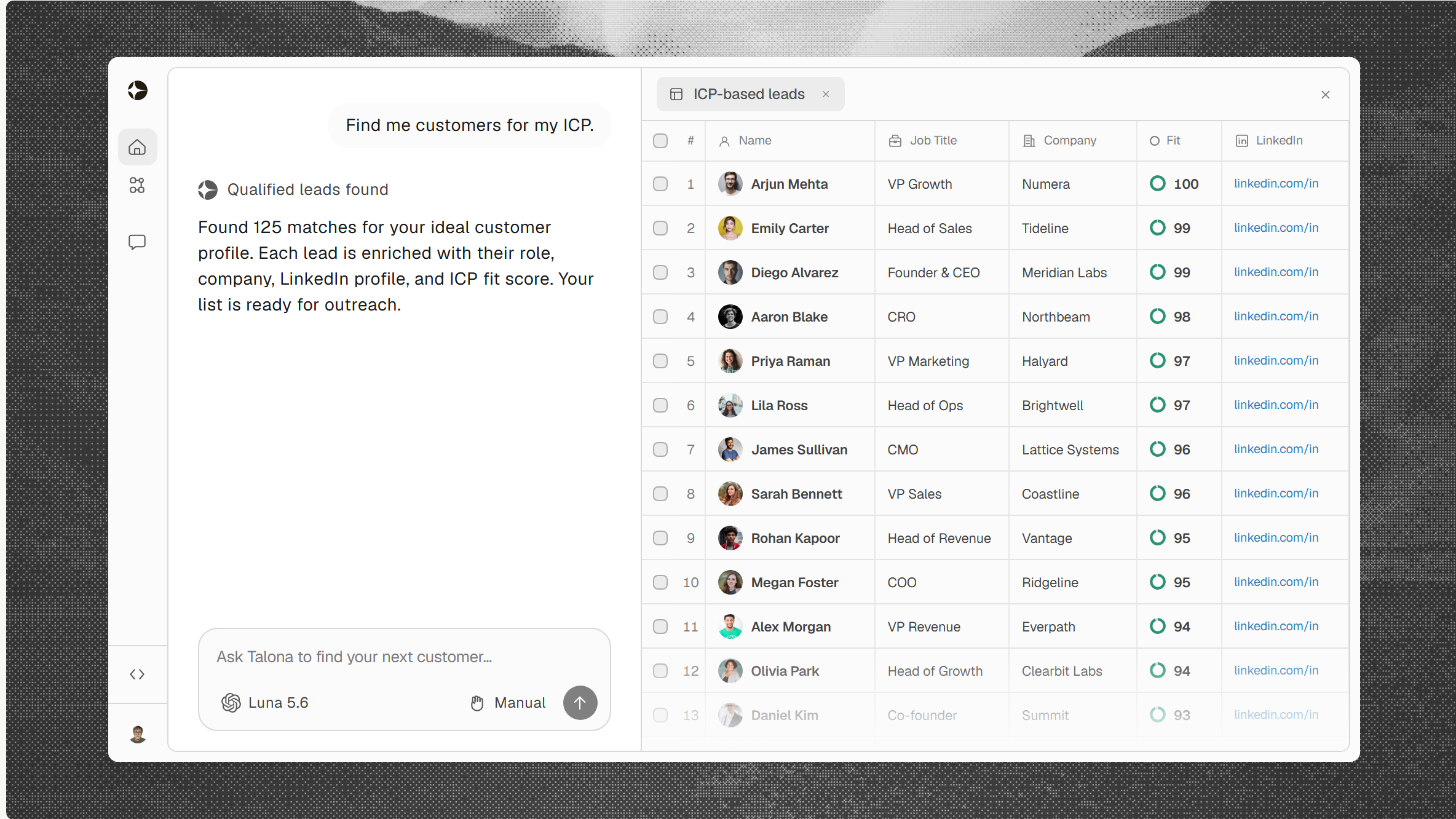
Talona researches the live web and social activity against the customer profile you describe. That research feeds the outreach itself: the agent uses the relevant company event and buyer context to start a useful conversation. A founder can refine the audience in chat while the agent handles the investigation and subsequent contact.
Test coverage against your actual market. A product for independent clinics, a developer tool, and a service for newly funded software companies require different sources. Give both products the same geography and exclusions, and record which relevant companies are missed as well as which irrelevant ones appear.
3. Buying signals and the reason to reach out
Origami’s signal product includes hiring, funding rounds, social posts, technology use, and company growth. It describes combining signals with targeting, such as looking at a recent funding event alongside recruitment activity. Origami buying signals
Talona connects a buying signal to the problem your product solves before using it in outreach. A Series A announcement can justify looking closer; hiring across several countries and creating a people-operations role give an onboarding product a more specific reason to contact the team. The agent carries that context into the conversation, so the founder does not have to research the same account again to write an opening message.
Separate three things during evaluation: evidence that an event happened, an inference about the problem it creates, and the person who owns that problem. Ask for dates and original sources. A timely headline with an unsupported explanation is a weaker lead than a smaller change that clearly affects the buyer’s work.
4. Contact enrichment and verification
Origami describes separate email and phone waterfalls that try multiple providers. Its overview names providers and distinguishes the contact lookup from the broader company research. This is a substantive part of its offer, rather than something Talona can claim competitors do not do. Origami contact enrichment overview
Talona enriches the people it finds with verified email and phone information. Contact data belongs to the same workflow as qualification and outreach, keeping the reason for the match attached to the person being contacted. You can review the list yourself or let the agent use those leads to continue the campaign.
Request the same contact fields from both products. Keep missing emails visible, distinguish a direct number from a company switchboard, and record the verification status. Count duplicate contacts once. A list with more filled cells is valuable only when those cells represent the information your next step actually requires.
5. Sequencing, replies, and meeting booking
Origami’s Sequencer supports social and email cadences, enrolling leads from the research workspace, and a shared inbox for replies. The product page states that replies pause a lead automatically. Origami Sequencer
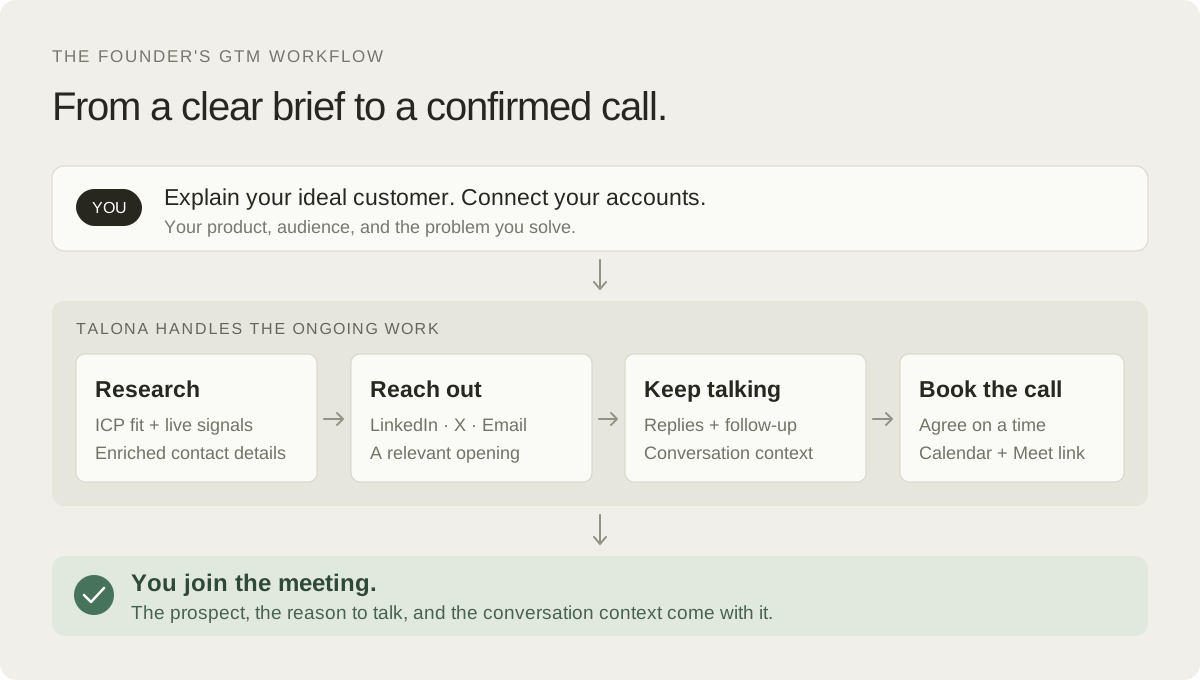
Talona handles outreach through the accounts you connect, including email, LinkedIn, and X. It keeps track of the conversation, responds in context, and follows up as the discussion develops. When the prospect agrees to a call, it arranges the time and creates the meeting in Google Calendar with a Google Meet link. The founder comes back to a confirmed conversation to attend.
This is the practical reason to choose Talona as a founder. A reply often creates more work: someone asks a question, suggests a colleague, or says next week would be better. Talona continues that exchange toward a meeting. In an Origami trial, inspect how the shared inbox handles those same situations and which decisions return to the person managing the sequence.
6. Lists, exports, and programmatic handoff
Origami’s API documentation covers sourcing and enriching lists, adding your own rows, reading results, and creating outreach campaigns. It also documents asynchronous jobs and webhooks. This provides a documented route for teams building a prospecting workflow around their own software. Origami API documentation
Talona lets a founder keep research and execution together. The agent can use the leads it discovers for outreach, continue the conversations, and arrange the meeting without requiring you to export a list into another sending tool. CSV import and export remain useful when you want to bring in existing prospects or share the research with a teammate.
An API matters when your team is building software around prospecting. For a solo founder, it may be more useful to avoid building that additional process in the first place. Evaluate Talona by giving it a customer brief and following the work through a reply and a calendar booking; evaluate Origami’s API if programmatic list or campaign operations are part of your requirements.
7. Pricing, credits, and the complete workflow
Origami lists Starter at $29 per month with 2,000 credits, Pro at $129 with 10,000, and Max at $399 with 30,000. The free plan has 1,000 one-time credits but excludes contact enrichment and CSV export. Paid plans include sequencing and unlimited teammates. Origami pricing
The pricing page lists 3 credits per returned verified email and 15 per verified phone; research operations have their own costs. Starter includes five email senders and one LinkedIn sender, with additional sender and inbox charges listed separately. Extra credits and optional automatic top-ups also affect spend. Origami pricing
Talona uses a shared credit balance for research and contact enrichment. The published allowances below make that part of your GTM budget easy to understand as you move from your first customers to a growing pipeline.
| Talona plan | Price | Allowance |
|---|---|---|
| Free | $0 | 200 credits to try it |
| Starter | $29/mo | 1,000 credits a month |
| Growth | $99/mo | 5,000 credits a month |
Standard lead research uses 5 credits, a returned verified email adds 3, and a returned phone number adds 15. A hypothetical batch of 100 researched leads with 100 verified emails therefore uses 800 credits. Adding a phone for every person adds 1500 credits. This is budget arithmetic, not an observed match rate; deeper research is estimated separately and missing contact information changes the total.
Paid plans include unlimited teammates. CSV exports and ICP conversations are included, and unsuccessful contact lookups are not charged. The free allowance is one-time, while paid allowances renew monthly. See Talona’s pricing for rollover, optional top-ups, and workspace limits. These figures describe research and contact data usage. When budgeting the complete workflow, include any connected account costs and the time your team spends overseeing outreach.
The identical Starter subscription price does not make credits interchangeable. Research, contacts, connected accounts, and campaign work contribute to the total differently. For a founder, include your own operating time: preparing a list, watching for replies, writing follow-ups, and coordinating a time all consume attention. Talona’s value is taking responsibility for those connected steps.
8. Collaboration and ongoing ownership
Both products describe shared use without per-seat fees on paid plans. For a small team, that makes it easier for a founder and another teammate to review the same prospecting effort without buying a second full subscription. Origami’s project and sender allowances still vary by tier. Origami pricing
Collaboration also depends on what people can understand and control. During a trial, have a teammate review a list they did not create. Can they identify why each person was included, remove the wrong ones, and continue the work without re-asking every question? For multiple clients, verify workspace separation and permissions rather than inferring them from the word “team.”
9. A practical side-by-side evaluation
- Write one brief with a buyer, geography, company range, timing signal, and explicit exclusions. Use the same version in both products.
- Review a fixed sample of returned leads before enriching more rows. Mark fit, wrong role, stale event, unsupported inference, and duplicate separately.
- Request the same contact fields and compare verified, missing, and uncertain results. Preserve the research explanation in the export.
- Record subscription cost, research usage, contact usage, and human review time. Separate discovery cost from outreach infrastructure.
- Follow the full conversation: include a product question, a delayed follow-up, and an agreement to meet. Record every time the founder needs to intervene and check the final calendar invitation.
Use cost per accepted lead as an early metric: total discovery and review cost divided by leads you would actually contact. Later, track qualified conversations and attended meetings. This avoids rewarding a tool for generating a large list that creates more work than opportunity.
Which product fits your next step?
Choose Talona if you are a solo founder or small team that wants a GTM agent working in the background. Its fit is strongest when your priority is a straightforward brief, relevant prospects, conversations handled across connected channels, and meetings arriving on your calendar without someone operating every stage.
Choose Origami if you want conversational research, enrichment, and email/social sequences that you work with directly. Its documented API is also a useful reason to prefer it when you are building a custom list or campaign process. Those capabilities remain valuable even when founder simplicity is the main lens for this comparison.
Start with the Talona demo and a real customer profile. In your evaluation, measure the work required from the first brief to the confirmed meeting. A founder’s best tool is the one that fits the way the business needs to grow and leaves enough time to build it.
Sources and further reading
The links below support the competitor details in this article. Prices are a dated snapshot; confirm the currency, billing period, usage allowance, and required add-ons before choosing a plan. Our recommendations are our interpretation of those capabilities and the workflow each product is designed to support.
- Origami lead generation
- Origami buying signals
- Origami contact enrichment overview
- Origami Sequencer
- Origami pricing
- Origami API documentation
For Talona’s approach, read about dynamic lead generation or explore the Talona GTM agent. You can also compare Talona with Gojiberry AI, Clay, Apollo, Explee.